


Aim: To evaluate and improve the management of anemia in chronic kidney disease (CKD) patients, ensuring adherence to established guidelines.
Methods: A retrospective analysis of medical records from 62 ESRD patients on maintenance hemodialysis (MHD) at EVERCARE HOSPITAL DHAKA receiving erythropoiesis-stimulating agent (ESA) therapy was performed. Audit criteria focused on screening rates, compliance with Hemoglobin (Hb) targets (<11.5 \ dl), iron status monitoring (every 3 months), and ESA dose adjustments.
Results: High compliance (>80\%) was observed for anemia screening (100.0%), timely Hb monitoring after ESA initiation (98.4%), and appropriate ESA dose adjustments (82.3%). However, compliance was critically low (<50\%) for Iron status documentation (35.5%) and Iron profile monitoring every 3 months (8.1%). Overall, only 62.9% of patients maintained their Hb within the KDIGO-recommended range (moderate compliance). Correlation analysis showed that ESA dose adjustments were strongly correlated (r > 0.70) with Hb maintenance.
Conclusion: While initial screening and ESA dose adjustment compliance are high, there is a significant gap in routine iron status monitoring and documentation, which is essential for optimizing erythropoiesis and achieving target Hb levels. Interventions focusing on improving iron profile surveillance are required.
Introduction
Clinical audit is defined as the process of critically and systematically assessing professional activities with a commitment to improving patient management and, ultimately, the quality of patient care. It serves as a key element of clinical governance and aims for improved patient care, enhanced professionalism, efficient use of resources, and aid to continuing education. The specific aim of this audit was to evaluate and improve the management of anemia in CKD patients, ensuring strict adherence to established guidelines.1 The primary objectives included assessing screening rates, evaluating the use of ESAs and iron supplements, analyzing the monitoring of Hb and iron status, and confirming that anemia treatment follows established guidelines.
Methods
Study Population and Setting
The audit involved a retrospective analysis of medical records for 62 ESRD patients on maintenance hemodialysis (MHD) at EVERCARE HOSPITAL DHAKA.
Inclusion and Exclusion Criteria
- Inclusion: All ESRD patients on MHD receiving ESA therapy.
- Exclusion: Patients on peritoneal dialysis or those with incomplete records.
Audit Criteria (Set Standards)
The audit compared collected data against set standards, which included:
- Frequency of anemia monitoring: At least every 3 monthly.
- Hemoglobin Target: Maintain Hb levels within the recommended range of <11.5 /dl.
- Iron Status Monitoring: Ferritin and transferrin saturation (TSAT) levels checked every 3 months.
- ESA Initiation: Initial Hb level ≤ 9-10 g/dl.
- ESA Monitoring: Hb levels monitored within 2-4 weeks after initiating ESA therapy.
Data Analysis
Data was compared against the standards to calculate the percentage of patients meeting each criterion. Gaps in adherence to anemia management guidelines were identified.
Results
Demographic Characteristics
- A total of 62 ESRD patients on MHD were included. Majority of patients (69.35%) were aged ≥60 years, indicating that older adults form the predominant group undergoing MHD
| Gender Distribution | Count (N) | Percentage (%) |
| Male | 26 | 41.9% |
| Female | 36 | 58.1% |
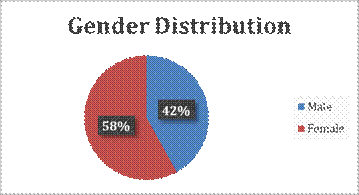
Figure: Gender Distribution
The data shows that the group is composed of a higher percentage of females (58.1%) than males (41.9%).
| Age Group Distribution | Count (N) | Percentage (%) |
| 18-30 years | 0 | 0% |
| 31-40 years | 1 | 1.61% |
| 41-50 years | 6 | 9.67% |
| 51-60 years | 10 | 16.13% |
| 61-70 years | 30 | 48.39% |
| 71-80 years | 13 | 20.97% |
| >80 years | 2 | 3.23% |
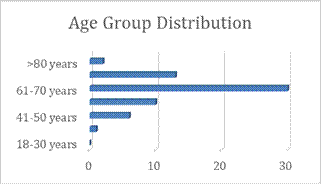
Figure: Age Group Distribution
This distribution suggests that the study or population being described is focused on or comprises a significantly older demographic, likely a study of geriatric or middle-aged to elderly people.
Compliance with Anemia Management Metrics
Compliance was categorized based on the percentage of patients meeting the standard
- High Compliance (>80%)
Anemia screening (100.0% compliance):
- This indicates that every single eligible patient was screened for anemia. Anemia screening typically involves blood tests to check levels of red blood cells or hemoglobin. 100% compliance is the highest possible achievement.
ESA dose adjustments (82.3% compliance):
- Erythropoiesis-Stimulating Agents (ESAs) are medications used to treat anemia, often in patients with CKD, by stimulating the bone marrow to produce red blood cells.
- This metric shows that 82.3% of the time an ESA dose needed to be adjusted (based on clinical guidelines or blood test results), the adjustment was correctly performed.
Hb monitoring after ESA initiation (98.4% compliance):
- Hb stands for Hemoglobin, the protein in red blood cells that carries oxygen.
- After a patient starts an ESA, it is critical to monitor their hemoglobin levels regularly to ensure the treatment is effective and to avoid over-treatment (which can lead to complications).
- This task was completed successfully for 98.4% of the patients who initiated ESA therapy.
Patient education completion (98.4% compliance):
- This refers to the process of providing patients with necessary information about their condition, treatment plan (like ESA therapy), potential side effects, and self-care instructions.
- The required patient education materials and discussions were documented as completed for 98.4% of the patients.
- Moderate Compliance (50-80%)
Kidney Disease Improving Global Outcomes (KDIGO) is an international organization that develops and publishes evidence-based clinical practice guidelines for kidney disease. These guidelines set the recommended target range for hemoglobin levels in patients with CKD, particularly those on Erythropoiesis-Stimulating Agents (ESAs) or other anemia treatments. The KDIGO target generally recommends maintaining the Hb level at less than 11.5 g/dL (or 115 g/L) and not intentionally maintaining it above 13 g/dL (or 130 g/L), as higher levels have been associated with increased risk of adverse cardiovascular events. The compliance is only 62.9% (Moderate), it means that for nearly 4 out of every 10 patients (37.1%), their hemoglobin levels were either too low (indicating under-treatment or uncontrolled anemia) or too high (indicating over-treatment, which carries serious risks like stroke or heart problems), according to the best practice standards.
- Low Compliance (<50%)
Iron status documentation: 35.5% compliance– This metric tracks whether a patient’s current iron status (including recent lab results like Ferritin and Transferrin Saturation (TSAT) and the prescribed iron therapy) was properly documented in the patient’s record at the required time or interval. The required documentation was completed for only 35.5% of the eligible patients or instances.
Iron profile monitoring every 3 months: 8.1% compliance – Clinical guidelines, such as those from KDIGO, recommend regular monitoring of the iron profile (which typically includes Ferritin and TSAT levels) for patients on anemia therapy (especially ESAs) to ensure they have enough iron stores to make new red blood cells. The required frequency here is every 3 months.
This crucial monitoring was performed correctly (every 3 months) for only 8.1% of the eligible patients. This is the lowest compliance rate of all the tasks.
Compliance with Clinical Audit Indicators
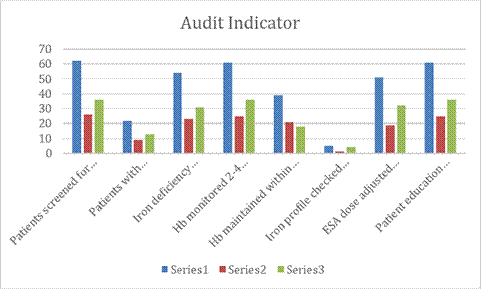
Figure: Audit Indicator
Anemia management metrics
Figure: Anemia management metrics
Correlation Analysis
A heatmap analysis revealed key correlations between management metrics
- Strong Correlation: ESA dose adjustments were strongly correlated with Hb maintenance (r > 0.70).
- Moderate Correlation: Iron profile monitoring showed a moderate positive correlation (r ≈ 0.50) with Hb maintenance.
- Moderate Correlation: Iron deficiency correction correlated with timely Hb monitoring (r ≈ 0.60).
- Weak Correlation: Anemia screening showed weak correlation with other indicators (<0.30).
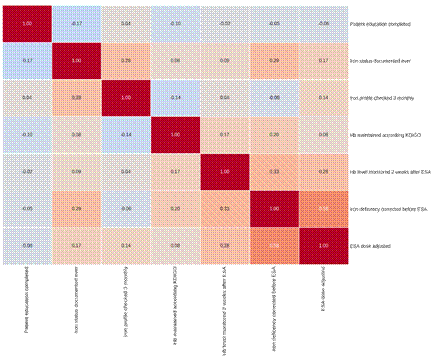
Figure: Correlation from Heatmap
Discussion
The management of anemia in ESRD patients on MHD shows excellent compliance with initial screening and patient education but demonstrates a critical need to improve routine iron status monitoring and documentation. Screening alone is insufficient; effective follow-up and intervention are required.
High Compliance with Anemia Screening and Hb Monitoring. The audit revealed a 100% compliance rate for anemia screening and 98.4% adherence to Hb monitoring within 2 weeks of ESA initiation. These results reflect robust screening protocols in the dialysis unit. 2
Suboptimal Iron Monitoring and Documentation. Only 35.5% of patients had documented iron status, and only 8.1% had iron profile assessments every 3 months, despite guideline recommendations for routine iron monitoring. This gap in monitoring may contribute to suboptimal Hb maintenance, as iron availability directly influences erythropoiesis. Furthermore, the heatmap analysis demonstrated a moderate correlation (r ≈ 0.50) between iron profile checks and maintaining Hb within the KDIGO-recommended range. Increasing the frequency of iron status documentation and adherence to 3-monthly iron assessments is essential to ensure ESA therapy effectiveness.
Hb Maintenance and ESA Dose Adjustments. The data showed that only 62.9% of patients maintained Hb within the KDIGO-recommended range (10-12 g/dL). Patients with appropriately adjusted ESA doses were significantly more likely to maintain their Hb within target levels (correlation r > 0.70), confirming the importance of individualized ESA dose titration. Clinical Implication: Optimizing ESA dose adjustments and increasing clinician awareness regarding Hb target ranges could improve patient outcomes.
Gender Disparities in Anemia Management. The gender-based analysis showed that male patients had a higher compliance rate (80.8%) for Hb maintenance within KDIGO guidelines compared to 50.0% in females. Although ESA dose adjustments were nearly equal among genders, females had slightly lower rates of iron status documentation (36.1% vs. 34.6% in males). Clinical Implication: Investigating potential physiological or clinical practice-related factors contributing to this disparity is necessary to ensure equitable anemia management.3
Impact of Patient Education on Compliance. 79.03% of patients received anemia management education, correlating positively with ESA dose adjustment compliance (r ≈ 0.55). This suggests that patients who receive structured education are more likely to adhere to ESA therapy and follow recommended monitoring schedules. Clinical Implication: Strengthening patient education programs can enhance treatment adherence and improve long-term anemia outcomes.
Conclusion
The audit highlights successes in anemia screening and Hb monitoring, while identifying significant gaps in iron status monitoring. Optimizing ESA therapy through tailored dose adjustments, improving iron monitoring adherence, and enhancing patient education are essential steps to improve anemia outcomes in ESRD patients on hemodialysis.
Recommendations and Future Directions
- Enhance iron status monitoring and documentation through regular assessments every three months aligned with guidelines.
- Implement EMR-integrated alerts and reminders to ensure compliance with anemia management protocols.
- Conduct staff training and workshops to raise awareness of anemia management best practices.
- Address gender disparities by investigating underlying causes and customizing interventions accordingly.
- Perform follow-up audits post-intervention to assess improvement in anemia management and patient outcomes.
Author:
- Dr. Mehadi Hasan, MBBS, MRCP, Specialist (Nephrology), Evercare Hospital, Bashundhara, Dhaka. Mobile: +8801713445275. Email: ebadurmr@gmail.com
Co-author(s):
- Dr. Ebadur Rahman
- Prof. Dr. Md. Masum Kamal Khan
- Dr. Fahmida Begum
- Dr. Tabassum Samad
- Dr. A. F. M. Noman
- Dr. Mahbubur Rahman
- Dr. Ummay Farwa Hoque
- Dr. Asma Jalal Panjery
- Dr. Anzuman Ara
- Dr. Fairooz Raisa
- Dr. Rubaiya Rahim
Reference
1. Locatelli F, Pisoni RL, Akizawa T, et al. Anemia management for hemodialysis patients: Kidney Disease Outcomes Quality Initiative (K/DOQI) guidelines and Dialysis Outcomes and Practice Patterns Study (DOPPS) findings. American Journal of Kidney Diseases. 2004;44(SUPPL. 2):27-33. doi:10.1053/j.ajkd.2004.08.008
2. Soffritti S, Russo G, Cantelli S, Gilli G, Catizone L. Maintaining over time Clinical Performance targets on Anaemia correction in unselected population on chronic dialysis at 20 Italian Centres. Data from a retrospective study for a Clinical Audit. BMC Nephrol. 2009;10(1):33. doi:10.1186/1471-2369-10-33
3. Fahmy S, Ahmad A, Hashem E. A clinical audit on the management of children with hepatorenal syndrome admitted to Assiut University Children Hospital. Journal of Current Medical Research and Practice. 2022;7(4):280. doi:10.4103/JCMRP.JCMRP_29_21