

Abstract
Hematological malignancies are an increasing public health challenge worldwide, with a particularly rapid rise in countries such as Bangladesh. This study of 430 patients from seven tertiary hospitals sought to identify the most prevalent blood cancers and explore the potential role of agricultural pesticide exposure. Alarmingly, individuals younger than 20 years accounted for the largest proportion of cases. Acute Lymphoblastic Leukemia and Acute Myeloid Leukemia emerged as the two most common diagnoses. Many affected men were farmers with chronic occupational exposure to pesticides. Although the association was not uniform across all patients, significant links were observed in specific subgroups, suggesting that pesticide exposure may contribute to disease risk. These findings underscore the urgent need for stronger occupational safety regulations, safer agricultural practices, and expanded hematology services throughout Bangladesh.
Introduction
Cancer has become an devastatingly important public health concern in Bangladesh, affecting a growing number of families each year. Projections suggest that the national cancer burden will rise substantially by 2030, placing significant pressure on an already strained healthcare system. Hematological malignancies, or blood cancers, represent a particularly serious group of disorders that originate in the blood-forming tissues and bone marrow. Because these diseases circulate throughout the body, they are often complex to diagnose and treat.1
A major challenge remains the absence of a comprehensive national cancer registry in Bangladesh, which limits accurate assessment of disease patterns and hampers effective planning of diagnostic and treatment services. At the same time, increasing attention has focused on environmental and occupational risk factors, particularly the widespread use of agricultural pesticides. These chemicals play an important role in crop production but may also pose long-term health hazards to farmers and rural communities. As pesticide use continues to expand, investigating its possible association with hematological malignancies has become both timely and essential. 2
Methods
To obtain a comprehensive picture of hematological malignancies in Bangladesh, this study was conducted across seven major tertiary care hospitals, including four in Dhaka and three in other large urban centers. Only patients aged 12 years and older with a confirmed diagnosis from bone marrow biopsy results and peripheral blood film examination were enrolled to ensure diagnostic accuracy.
The study was carried out over a one-year period from July 2017 to June 2018. A total of 430 patients were interviewed using a structured questionnaire that collected detailed information on age, place of residence, occupation, smoking history, and pesticide exposure. Particular attention was given to both occupational and household pesticide use, allowing comparison between individuals with minimal exposure and those with substantial, long-term contact with these chemicals.
Results
Among the 430 patients included in the study, the majority were male (67%), while females accounted for 33%. The mean age was approximately 35 years, indicating a concerning pattern of disease occurrence in relatively young individuals. This early age distribution is particularly alarming, as it affects individuals during their most productive years, often when they are the primary economic support for their families.
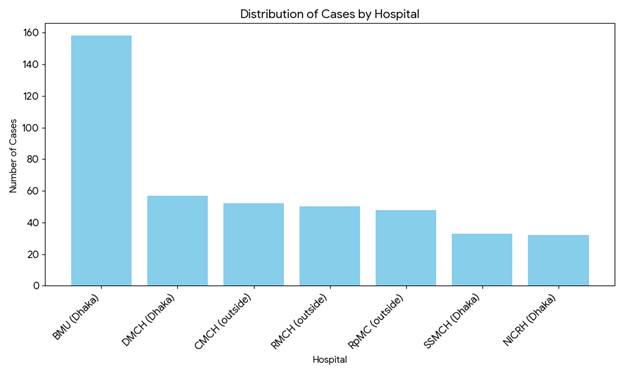
| Hospital | Cases | Percent |
| BMU (Dhaka) | 158 | 37 |
| DMCH (Dhaka) | 57 | 13 |
| SSMCH (Dhaka) | 33 | 8 |
| NICRH (Dhaka) | 32 | 7 |
| RpMC (outside) | 48 | 11 |
| RMCH (outside) | 50 | 12 |
| CMCH (outside) | 52 | 12 |
| Total | 430 | 100 |
The most frequently observed malignancy in this cohort was Acute Lymphoblastic Leukemia (ALL), accounting for approximately 27% of all cases. This was closely followed by Acute Myeloid Leukemia (AML) at 25%. Among patients under 20 years of age, ALL emerged as the predominant diagnosis, highlighting its disproportionate impact on younger populations. Other hematological malignancies, including Chronic Myeloid Leukemia (CML) and Non-Hodgkin Lymphoma, were also identified but occurred less frequently in comparison.
| Cancer Type | Percent | Median Age | Male: Female |
| ALL | 27 | 20 | 2:1 |
| AML | 26 | 34 | 1.3:1 |
| NHL | 16 | 50 | 3.8:1 |
| CML | 10 | 42 | 2.9:1 |
| HL | 7 | 34 | 4.3:1 |
| MM | 8 | 55 | 1.8:1 |
| Total | 100 | 35 | 2:1 |
Occupational and lifestyle patterns were also assessed in this cohort. Approximately 70% of patients were married. A substantial proportion were students, while others were engaged in agriculture or household-based work.
Pesticide exposure demonstrated a marked gender and occupation-based difference. Among male patients, 43% reported regular use of pesticides, primarily in large-scale farming activities. In comparison, only 19% of female patients reported exposure, which was generally limited to small household gardens or domestic use.
Further analysis indicated a higher burden of hematological malignancies among men involved in agricultural work with frequent pesticide exposure. This pattern suggests a possible association between occupational contact with farm chemicals and increased risk of blood cancers, particularly within rural farming communities.
Discussion
This study highlights several important public health concerns in Bangladesh. First, hematological malignancies are disproportionately affecting younger populations, with a significant number of cases occurring in individuals under 20 years of age. This raises serious concern for long-term national health outcomes and future workforce productivity. In addition, the concentration of specialized oncology services in Dhaka creates major access barriers for rural and low-income populations. Patients from remote areas often face long travel distances and substantial financial burden to reach diagnostic and treatment centers, increasing the likelihood of delayed or missed diagnoses. 3
Occupational pesticide exposure also emerges as a key area of concern. In many rural settings, farmers frequently apply pesticides without adequate protective equipment due to cost constraints and discomfort in hot climates. Findings suggest that repeated dermal and inhalational exposure may contribute to increased hematological cancer risk. This risk appears to be further amplified among individuals who also smoke, indicating a possible synergistic effect between tobacco use and chemical exposure. 4
Several limitations should be acknowledged. The study was limited to a one-year period and included data from only seven hospitals, which may not fully represent the national burden. Long-term prospective studies, along with environmental assessments of soil and water contamination, are needed to better understand chronic exposure pathways and their role in disease development. 5
Conclusion
In conclusion, this study shows that ALL and AML are the leading hematological cancers in Bangladesh. The high number of cases among young people and working-age adults is particularly alarming, with major social and economic consequences.
The findings suggest an association in certain groups between occupational pesticide exposure and increased risk of blood cancers in certain groups, highlighting an urgent need for preventive measures. Improving farmer education on safe pesticide use, encouraging protective practices, and exploring safer agricultural methods are essential. In parallel, expanding cancer diagnosis and treatment services beyond major centers such as Dhaka is critical to improve access and reduce delays in care. Without action on both occupational safety and healthcare access, the burden of disease is likely to continue increasing.
Author of this article
Prof. Dr. Amin Lutful Kabir, MBBS, MPhil, FCPS (Hematology), Professor, (Hematology), Bangladesh Medical University, Dhaka, Bangladesh
References
- Hussain SA, Sullivan R. Cancer control in Bangladesh. South Asian Journal of Cancer. 2013.
- World Health Organization. Cancer Country Profile: Bangladesh 2020.
- Smith A, Howell D, Patmore R, Jack A, Roman E. Incidence of haematological malignancy by sub-type: a report from the Haematological Malignancy Research Network. British Journal of Cancer. 2011.
- Shammi M, Sultana A, Hasan N, et al. Pesticide exposures towards health and environmental hazard in Bangladesh. Journal of the Saudi Society of Agricultural Sciences. 2020.
- Terwilliger T, Abdul-Hay MJ. Acute lymphoblastic leukemia: a comprehensive review and 2017 update. Blood Cancer Journal. 2017.